
Passports, health, packing and everything else worth sorting out before July 2027
Fly into King Shaka International Airport (DUR), Durban. It is 18 km from the Protea Hotel Umhlanga — roughly 20 minutes by road.
Airport transfers on arrival and departure are not included in the reunion package. Arrange your own transfer, or let the organisers know your flight details early and they will try to group people onto shared transfers.
Both post-reunion tours end with an included transfer back to King Shaka — 4 August for the short tour, 8 August for the full one. Book your return flight for the afternoon or evening of those days.
Validity. Every traveller’s passport must be valid for at least six months beyond your intended departure date. Less than that and you may be refused entry.
Blank pages. You need at least two consecutive blank pages for visas and stamps. Insufficient blank pages can mean being denied entry or exit.
Visas. Check well in advance whether you need a tourist visa for South Africa, and what it costs. Visa requirements and costs are each traveller’s own responsibility.
Medication. Bring your own chronic medication for the whole trip, plus the usual: headache tablets, anti-inflammatories, a broad-spectrum antibiotic, motion-sickness tablets, anti-allergy medication, antihistamine cream or tablets, and mosquito repellent.
Vaccinations. Check with your travel clinic well before you fly whether you need anything (Yellow Fever, for example) for the countries on your itinerary.
Malaria. Parts of the region are malaria areas, from low to high risk. Discuss prophylactics with your doctor or travel clinic. Avoid bites: long sleeves and trousers in the evening, repellent, and sleep under a net or with a fan or air conditioning.
Wildlife viewing. A good pair of binoculars per adult is worth its weight. If you are bringing a camera, pack enough memory cards, a way to back up photos, the battery charger and the manual.
Sun. A cap or wide-brimmed hat, sunblock and decent sunglasses.
Clothing. A couple of neutral-toned items are useful — no need to overdo it. Good walking shoes are advisable. Bush temperatures swing hard, so bring layers. July and August are winter here: pack a beanie, gloves and a scarf for early morning game drives.
Allowance. Check the limits on your international and local flights. Pack light — most hotels and lodges offer a laundry service, some complimentary.
Bag type. Soft-sided bags are required for smaller shuttle flights and are easier to fit into vehicles generally. Hard suitcases are often a problem.
Standard allowance. Transfers are planned on one normal suitcase plus up to two pieces of hand luggage per person. If you are travelling with more than that, or with sports or professional camera equipment or oversized bags, tell the organisers well in advance — extra charges may apply.
Tell your bank you are travelling, so your card is not blocked on an unusual transaction.
Acceptance. Most hotels, lodges and shops accept cards. Visa and Mastercard are widely accepted; AMEX and Diners much less so.
Cash. ATMs are available at airports, in cities and in most towns, dispensing South African Rand.
Card payments to the operator carry a transaction surcharge of up to 3.5% depending on card type.
Wi-Fi is available at most lodges, hotels and guest houses — sometimes limited in speed, or only in public areas. Malls, restaurants and coffee shops often have free Wi-Fi, but not all networks are secure.
eSIM. For calls and data away from Wi-Fi, load an eSIM for South Africa onto your phone before you travel. If your phone does not support eSIM, you can buy a local SIM pre-loaded with data at most international airports. 4G covers most urban areas — much less so out in the wilderness.
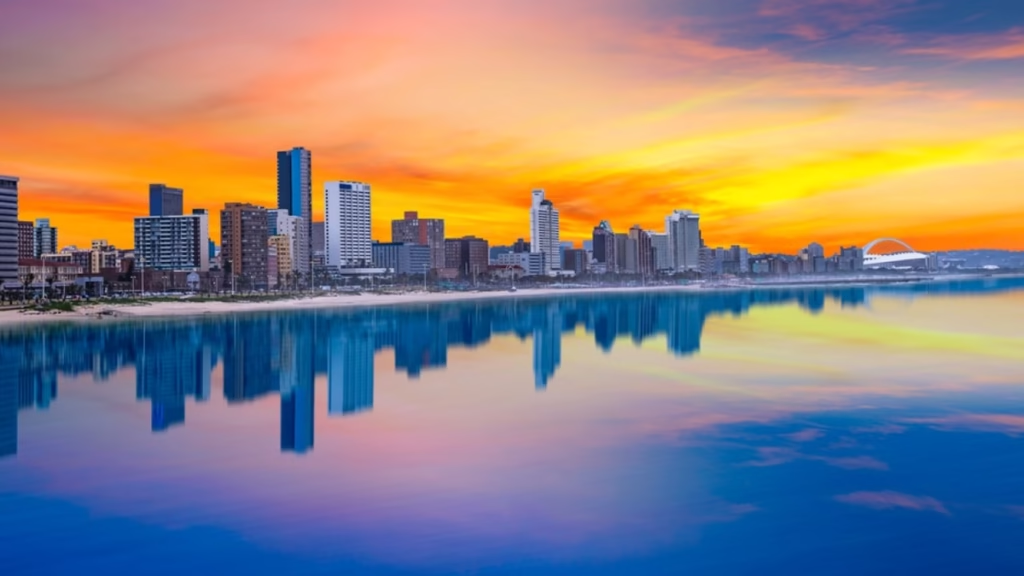
One of the most culturally and geographically diverse places on earth. Known locally as the Rainbow Nation, South Africa has eleven official languages and a population shaped by a remarkable mix of cultures.
There are gourmet restaurants, a serious art scene and beautiful beaches in Cape Town; a braai in Soweto; the bustling Indian markets of Durban; and some of the world’s finest wines in the Cape Winelands. For history, there are the Zululand battlefields of KwaZulu-Natal, the Apartheid Museum in Johannesburg and Robben Island. And above all there is the untamed wilderness and the range of wildlife roaming freely across enormous unfenced reserves.
Comprehensive travel insurance is essential and is each traveller’s own responsibility. It protects you against the cost of cancellation — whether by you, the organisers or a supplier — for circumstances nobody can foresee. If you choose not to insure, or under-insure, there is no obligation on anyone to negotiate a refund or credit on your behalf.
Take out cover as soon as your invoice is issued.
Places are confirmed on a first-come basis and final pricing is set on numbers, so the sooner the organisers know you are coming, the better.
Or contact Garry Oftebro directly — garry@oftebro.co.za · 082 801 8860